
LED display glossary
Short, plain-language definitions of the terms you will meet in LED display proposals and datasheets.
- Pixel pitch
- The distance in millimeters between the centers of two adjacent pixels. A smaller pitch places more pixels in the same area. The right pitch depends on viewing distance and content.
- Native resolution
- The number of pixels across the width and height of the finished canvas. It follows from the canvas dimensions and the pixel pitch.
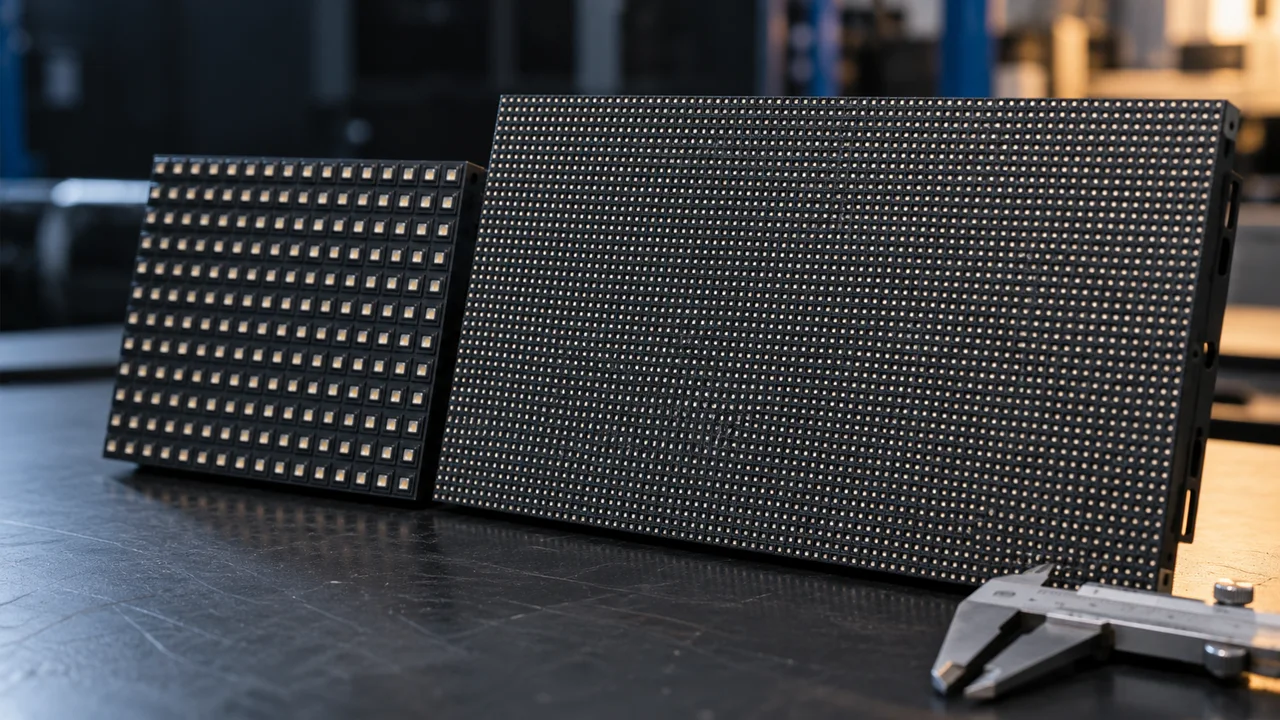
- Module
- A board assembly containing LEDs that forms part of the display. Module size, mounting and replacement method depend on the product design.
- Cabinet
- The frame that holds modules, power supplies and the receiving card. Cabinets are joined to build the full screen.
- Brightness (nits)
- Display luminance, measured in candela per square meter (nits). Visibility depends on ambient light, content contrast and the selected operating brightness.
- Refresh rate
- The frequency of LED driver output cycles, expressed in hertz (Hz). It is distinct from the video content frame rate and affects how the screen appears on camera.
- Grayscale
- The number of brightness levels each color channel can show. Higher grayscale supports smoother gradients, especially at low brightness.
- Viewing angle
- The range of angles over which the image keeps acceptable brightness and color.
- IP rating
- An ingress protection code defined in IEC 60529. The first digit rates protection against solids, the second against water. Front and rear ratings can differ.
- SMD
- Surface-mounted device: LED packages soldered onto the surface of the module board.
- COB
- Chip on board: LED chips mounted directly on the board and sealed under a continuous encapsulation layer.
- GOB
- A transparent protective coating over SMD modules. Impact and moisture protection must be confirmed for the particular product and test conditions.
- Sending card / controller
- Equipment that receives the video source and distributes display data to the cabinets.
- Receiving card
- A control board that receives display data and sends signals to the LED modules. Its location and supported module layout depend on the display design.
- Front / rear service
- Whether modules and components are accessed from the front of the screen or from behind it.
- Calibration
- Measuring and correcting brightness and color across modules so the canvas looks uniform.
Definitions are general. Values for any of these terms are confirmed for the specific model and configuration in a project proposal.
Ask about a term in your proposalStart with your application, size and destination
Compare display directions and prepare a clear project brief.